How to write a cover letter, with an example
Updated ·3 min read
Not every hiring manager reads cover letters. But the ones who do use them to decide between similar candidates, and some postings require one. A short, specific letter can be the reason you get the interview over someone with a similar resume.
Here's the structure, a full example, and what to avoid.
The structure of a cover letter
A strong cover letter is three or four short paragraphs, about 250 to 400 words, on one page:
- Header: your name and contact details (matching your resume), the date, and the employer's details if you have them.
- Greeting: the hiring manager by name if you can find it ("Dear Ms. Chen,"); otherwise "Dear Hiring Manager,".
- Opening: the role you're applying for and the single strongest reason you fit.
- Middle (one or two paragraphs): two or three specific achievements from your experience, connected to what the posting says the job needs.
- Close: a confident, brief invitation to talk, and thanks.
- Sign off: "Sincerely," or "Kind regards," and your name.
Write an opening that isn't a cliché
The first sentence is the one most likely to be read. Skip "I am writing to express my interest in..." and say something that only you could write.
Weak
I am writing to express my interest in the Data Analyst position at your company.
Strong
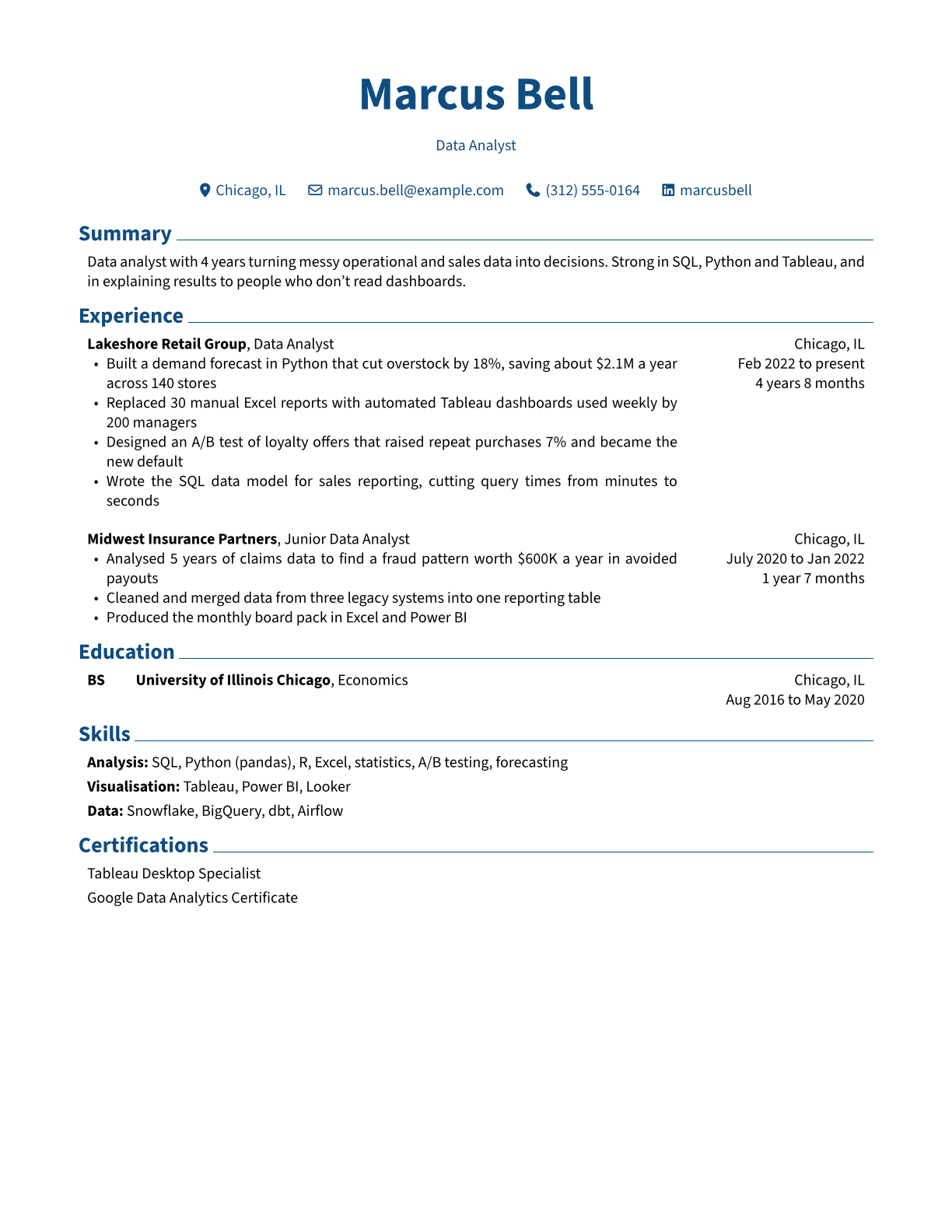
Your posting for a data analyst asks for someone who can turn demand data into decisions. At Lakeshore Retail Group, my forecast cut overstock by 18% across 140 stores.
Weak
I am a passionate and dedicated nurse seeking a new opportunity.
Strong
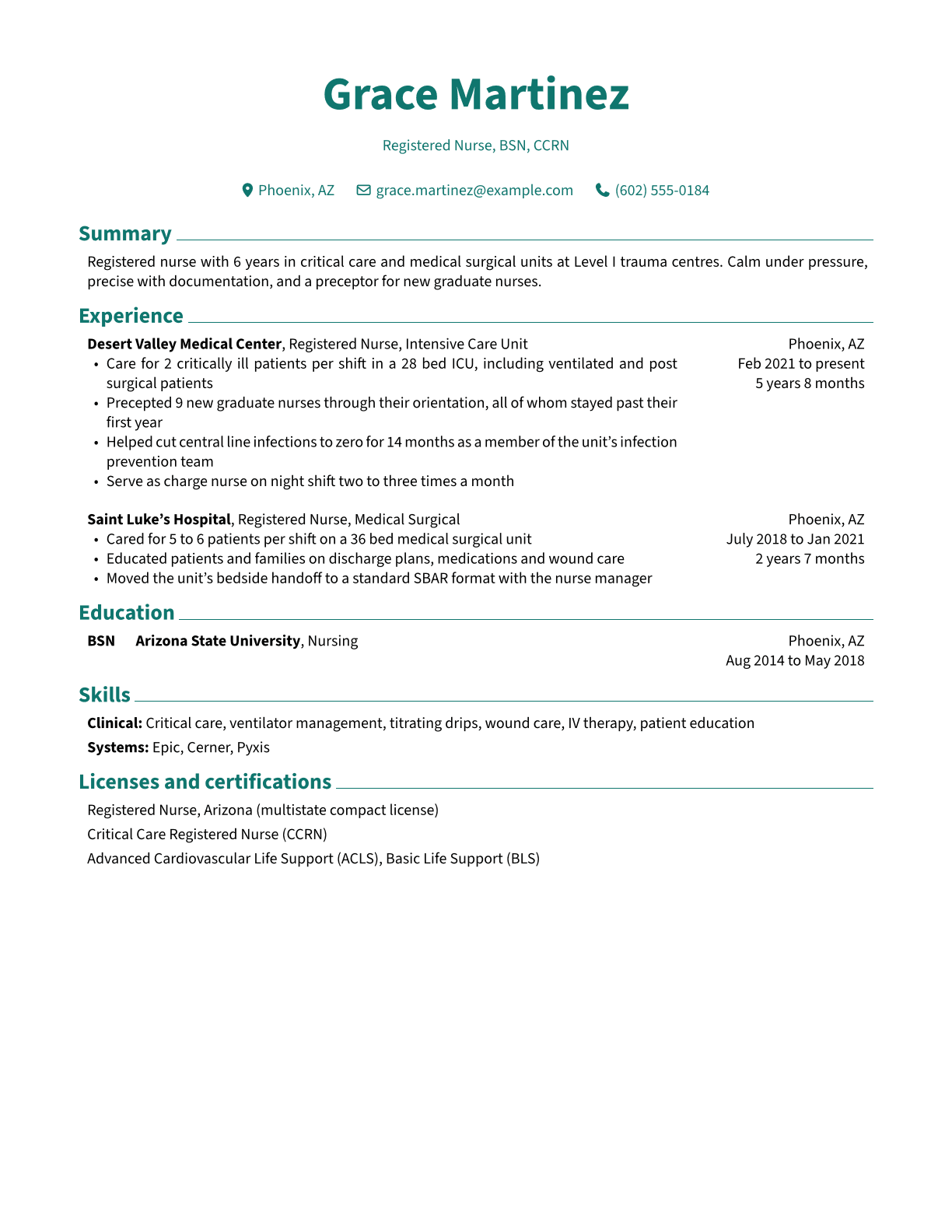
I'm applying for the ICU nurse position at Desert Valley. For the last five years I've cared for critically ill patients in a 28 bed ICU, and precepted nine new graduate nurses.
A cover letter example
Dear Hiring Manager,
I'm applying for the Senior Backend Engineer role on your payments platform team. Your posting asks for someone who can make critical payment systems faster and more reliable, and that's the work I've done for the last five years at Northwind Payments.
Most recently, I cut checkout p99 latency from 1.4 seconds to 380 milliseconds by replacing a synchronous ledger write with a durable queue. I also led the migration of 40 services off a shared Postgres instance, which removed the last single point of failure in our payments path. Both projects meant working closely with product and operations to ship changes without customer impact, which your posting highlights.
Before Northwind, I built an ingestion pipeline at Cobalt Analytics that processes 2 million events a day with guaranteed delivery, so the scale you describe is familiar ground.
I'd welcome the chance to talk about how I could help your team. Thank you for your time and consideration.
Sincerely,
Alex Rivera
Notice what it does: every claim is specific and comes from the resume, each achievement is linked to something the posting asked for, and it's under 250 words.
Tips that make a difference
- Match it to the posting. Mirror the two or three things the job ad emphasises most.
- Don't repeat your resume. Pick a few achievements and explain why they matter for this role.
- Use the same header as your resume so the two look like a set.
- Keep it to one page. Three or four paragraphs is plenty.
- Name the company and role correctly. Reusing a letter with another company's name in it is a fast rejection.
- Cut clichés such as "passionate", "team player" and "think outside the box".
- Send it as a PDF unless the application asks otherwise.
Using AI to write a cover letter
AI can produce a solid first draft quickly, but generic AI letters have two problems: they sound like everyone else's, and they sometimes invent experience you don't have. If you use AI, give it your real resume and the actual posting, and check every claim before you send it.
The Sembis cover letter generator is built around those rules: it drafts from your own resume and the posting, is instructed never to invent facts, and runs a second check that flags any detail the resume doesn't support.
Frequently asked questions
Do I need a cover letter?
When a posting asks for one, always. When it's optional, a short, tailored letter can help you stand out, especially for competitive roles or career changes.
How long should a cover letter be?
About 250 to 400 words, in three or four paragraphs, on a single page.
Who should I address a cover letter to?
The hiring manager by name if you can find it on the posting, the company website or LinkedIn. Otherwise, "Dear Hiring Manager" is fine.